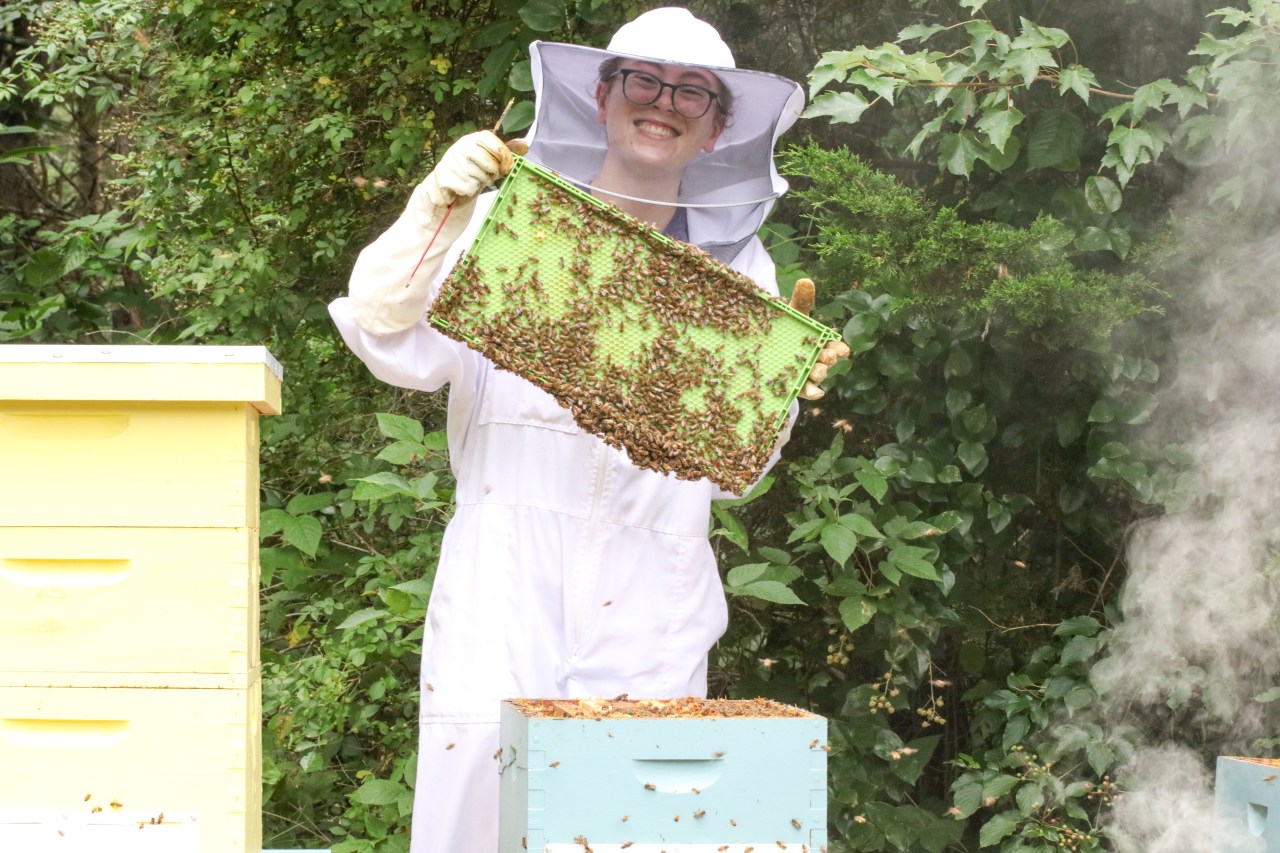
Last summer, Kaitlyn Bresnahan (Providence College student who also happens to be a beekeeper!) sampled bees of various castes and ages from her own hives in Cape Cod, MA. During the fall, Kaitlyn ran nutritional analyses for carbon and nitrogen content of each type of bee to see which bees might be more “expensive” to raise. It turns out drones, or male honey bees, are loaded with nitrogen. This means that developing drones likely need lots of nitrogen-rich pollen. Interestingly, forcing honey bees to raise drones is a chemical-free method beekeepers use to manage a costly pest.
One of the biggest threats honey bees face is Varroa destructor–a mite that sucks on bee tissue, which weakens bees and spreads disease. While there are many mite-killing chemicals on the market, many such chemicals are insecticides that likely do not discriminate between mite and bee. For this reason, many beekeepers have turned to physical ways of managing the mites in their hives, or integrated pest management (IPM). Based on Kaitlyn’s preliminary research, the IPM strategy beekeepers most commonly use–forcing bees to raise nitrogen-rich drones–may force worker bees to shift foraging strategies and reallocate nutritional stores and thus, have an unanticipated detrimental effect on the colony.
This summer, Kaitlyn is working with members of both the Rhode Island Beekeepers Association and Barnstable County Beekeepers Association to collect data on foraging rate, nutritional content of food collected, and population size from hives subjected to the IPM strategy of interest. Follow along on social media to see what Kaitlyn finds, and check out her original preliminary results on PC Digital Commons here.

 Providence Pollinator Lab